

The Saul Kripke Center is starting a new public philosophy initiative: The Analytic Salon. Learn more about it, and get involved, here.
Category: Events
Inhabiting Kripke’s truth via a working paracomplete formal arithmetic
The Saul Kripke Center is pleased to announce that Bryan Alexander Ford (DEDIS, EPFL) will deliver a talk on Monday, March 23rd, 2026, from 10:00 am to 12:00 pm at the CUNY Graduate Center (Room 9205). The talk is free and open to all.
Title: Inhabiting Kripke’s truth via a working paracomplete formal arithmetic
Abstract: While Kripke inspired numerous alternative approaches to truth and paradox, could we accomplish something like ordinary “working mathematical reasoning” in any of them? Yes. Grounded arithmetic (GA) combines paracomplete reasoning and computational semantics into a concrete, usable, and powerful Peano-esque formal theory of natural numbers and computation. GA weakens key classical inference rules with “habeas quid” preconditions: obligations to prove we “have a thing” before using it in subsequent reasoning. In reward for this inconvenience, GA permits unconstrained recursive definitions of both functions and predicates, including traditional classical and intuitionistic paradoxes like the Liar or Curry’s, but also including useful constructs like a simple mutually-recursive formulation of Cantor pairings. GA includes powerful quantifiers that yield a natural resolution of Yablo’s paradox. In contrast with classical arithmetic, all of GA’s logical connectives including quantifiers reduce to ordinary computations in basic grounded arithmetic (BGA), a minimalistic formal foundation for recursive computation. A mechanically-checked metatheory development shows that BGA has properties defying the conventional interpretation of Gödel’s incompleteness theorems by being simultaneously (a) semantically and syntactically consistent, (b) semantically complete, and (c) sufficiently powerful to represent any recursive (Turing-complete) computation. Ongoing work reinterpreting classical results from this Kripke-inspired paracomplete perspective suggests that Cantor’s theorem may have (always) been a “paradox in hiding” and that the Axiom of Choice may have been blameless for the Banach-Tarski paradox.
Young Scholars Series: David Santamaria Legarda
The Saul Kripke Center is pleased to announce that David Santamaria Legarda (PhD student, Philosophy, CUNY Graduate Center) will deliver the eleventh Saul Kripke Center Young Scholars Series talk on Wednesday, February 25, 2026, from 11:45 am to 1:45 pm at the CUNY Graduate Center (Room 9206). The talk is free and open to all.
Title: Cantor’s notion of inconsistent multiplicity
Abstract: In this talk I will (i) discuss the distinction between the so-called consistent and inconsistent multiplicities that we find in Georg Cantor’s (1845-1918) set theory. I will then (ii) examine whether Cantor’s theory was vulnerable to the paradoxes of set theory at any stage in its development and (iii) evaluate the claim that inconsistent multiplicities were introduced by Cantor in an ad hoc fashion to resolve these paradoxes. I will also (iv) look at the use Cantor makes of inconsistent multiplicities in his alleged proof that every set can be well-ordered, (v) defend Saul Kripke’s (1940–2022) claim that Cantor’s proof in his letters is successful, and (vi) draw some conclusions as to why he did not publish this proof.
Debating Dynamic Semantics
The Saul Kripke Center is hosting a two-day conference in the philosophy of language and logic, focused on dynamic semantics, especially as it pertains to modality. Both junior and senior experts will debate approaches to dynamic semantics.
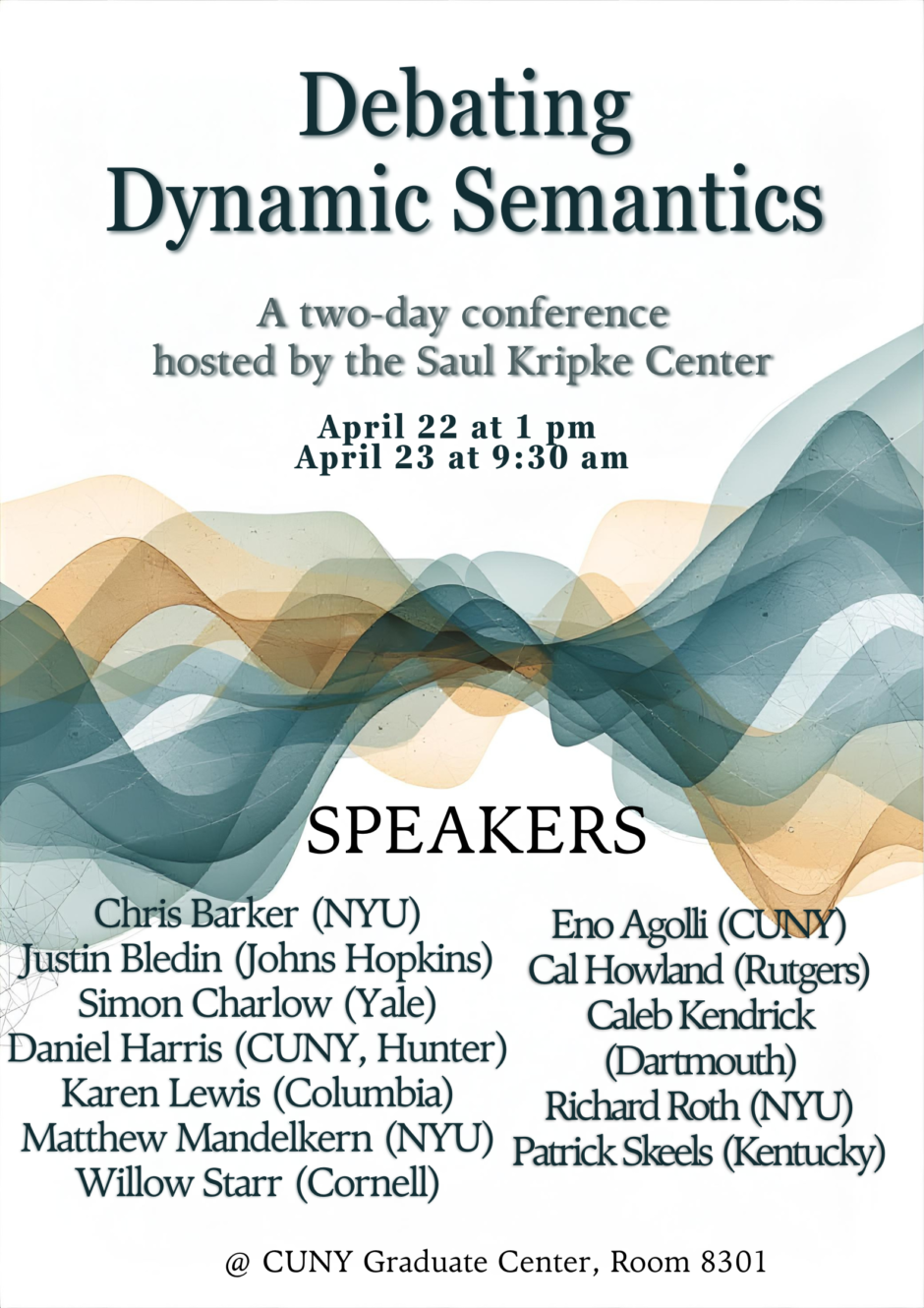
The conference will be organized as an exclusively in-person event. Attendance is open, without registration or cost, to anyone who is interested (Building Entry Policy). The conference program is available here.
Note: There is an associated call for papers here.
Summer Logic Double Feature
The Saul Kripke Center is pleased to announce that Nils Kürbis (Bochum) and Heinrich Wansing (Bochum) will deliver talks on Wednesday, June 11th, 2025, at the CUNY Graduate Center (Room 9207). The talks are free and open to all.
Title (1): A Theory of Definite Descriptions for Modal Logic
Time (1): 2:00 to 3:00 pm
Speaker (1): Nils Kürbis (Bochum)
Abstract (1): I’ll present a theory of definite descriptions in positive free logic, where definite descriptions ‘the F’ are formalised as in the context of complete sentences ‘The F is G’ by a binary quantifier as Ix(F, G). Formalised in natural deduction or sequent calculus, the theory satisfies certain proof-theoretic requirements demanded by proof theoretic semantics. Thus the meaning of I can be taken to be defined by its rules of inference. Positive free logic has been fruitfully applied in quantified modal logic. So I’ll consider what happens when modal operators are added. It turns out that the semantic clauses for Ix(F, G) are exactly those of Fitting and Mendelsohn (First Order Modal Logic, 2nd edition, Springer 2023), except that they formalise ‘The F is G’ by the iota operator for ‘the’ and the lambda for predicate abstraction to mark scope. I’ll end the talk with a brief comparison between the two systems.
***
Title (2): Solving a New Paradox of Deontic Logic (and a dozen other paradoxes) with RNmatrices for MC-based Modal Logics
Time (2): 3:00 to 4:00 pm
Speaker (2): Heinrich Wansing (Bochum) [joint work with Daniel Skurt (Bochum)]
Abstract (2): In this paper, we present RNmatrices (restricted non-deterministc matrices) for normal and non-normal modal expansions of the material connexive logic MC. We introduce and solve a paradox of deontic logic that to the best of our knowledge has not yet been been discussed in the literature and that justifies the use of a connexive, and actually hyperconnexive, non-modal base logic.
Beyond the Outline: A Celebration of Fifty Years of Kripke on Truth
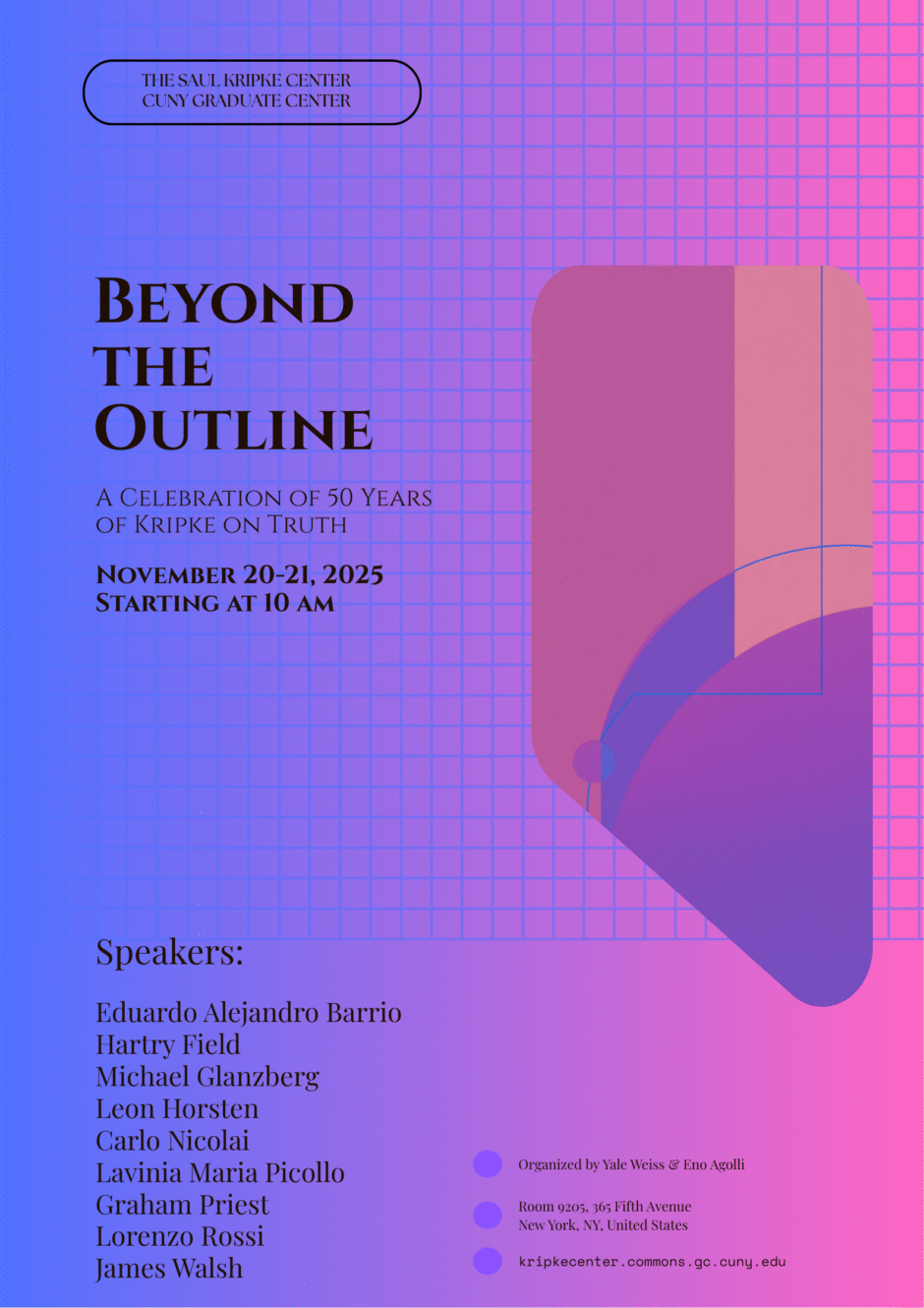
To mark the 50th anniversary of the first publication of Saul Kripke’s influential paper, “Outline of a Theory of Truth”, the Saul Kripke Center will host a major international conference on theories of truth at the CUNY Graduate Center in New York City on November 20 and 21, 2025. The conference will be organized as an exclusively in-person event. Attendance is open, without registration or cost, to anyone who is interested (Building Entry Policy). The conference program is available here.
The Myth of the Ungiven
The Saul Kripke Center is pleased to announce that Kit Fine (Silver Professor and University Professor of Philosophy and Mathematics at NYU) will deliver the 6th Saul Kripke Lecture on October 31st, 2024, from 4:00 to 6:30 pm. The talk is free and open to all, and will be held in-person only at the CUNY Graduate Center (Room C198).
Title: The Myth of the Ungiven
Abstract: The notion of a borderline case has been thought to be central to our understanding of vagueness. I shall argue that there is no intelligible notion that can play this role and that an alternative framework for understanding vagueness needs to be found.
Modal definability and Kripke’s theory of truth
The Saul Kripke Center is pleased to announce that James Walsh (Assistant Professor, Philosophy, NYU) will deliver a talk on Friday, May 10th, 2024, from 4:15 to 6:15 pm at the CUNY Graduate Center (Room 9207). The talk is free and open to all.
Title: Modal definability and Kripke’s theory of truth
Abstract: In Outline of a Theory of Truth, Kripke introduces some of the central concepts of the logical study of truth and paradox. He informally defines some of these–such as groundedness and paradoxicality–using modal locutions. We introduce a modal language for regimenting Kripke’s informal definitions and characterize the modally definable sets. Though groundedness and paradoxicality are expressible in the modal language, we prove that intrinsicality–which Kripke emphasizes but does not define modally–is not.
Zoom Access: please follow this link.
Young Scholars Series: C. L. Johnson
The Saul Kripke Center is pleased to announce that C. L. Johnson (PhD student, Philosophy, CUNY Graduate Center) will deliver the tenth Saul Kripke Center Young Scholars Series talk on Thursday, February 22, 2024, from 4:15 to 6:15 pm at the CUNY Graduate Center (Room C197). The talk is free and open to all.
Title: On the existence of all possible worlds
Abstract: Why is there something rather than nothing? In “Why Anything? Why This?”, Derek Parfit canvasses several ultimate explanations for existence and their pitfalls, conceding that the possibility for any cogent answer to the question is unlikely. I nevertheless provide such an explanation first by enumerating foundational assumptions common to most, if not all, explanations. From these assumptions, I argue against two popular views regarding the existence of our world: (1) the existence of a necessary being responsible for our world’s creation and (2) the brute existence of our world. Then, by developing an account against the coherence of nothingness, I critique the possibility of Absolute Nothingness, the view that the simplest reality is one devoid of anything. In so doing, I underscore the difference between ontological and explanatory simplicity, showing that though a finite reality (in either the number of worlds or scope) is ontologically simpler than an infinite one (in both number and scope), such a finitude is explanatorily more complex and arbitrary. I then argue that an unbounded Maximality of infinitely many, spatiotemporally disconnected worlds (the opposite of Absolute Nothingness) is the simplest ground (or default state) for our existence, effectively requiring no further explanation.
Saul Kripke Memorial Conference
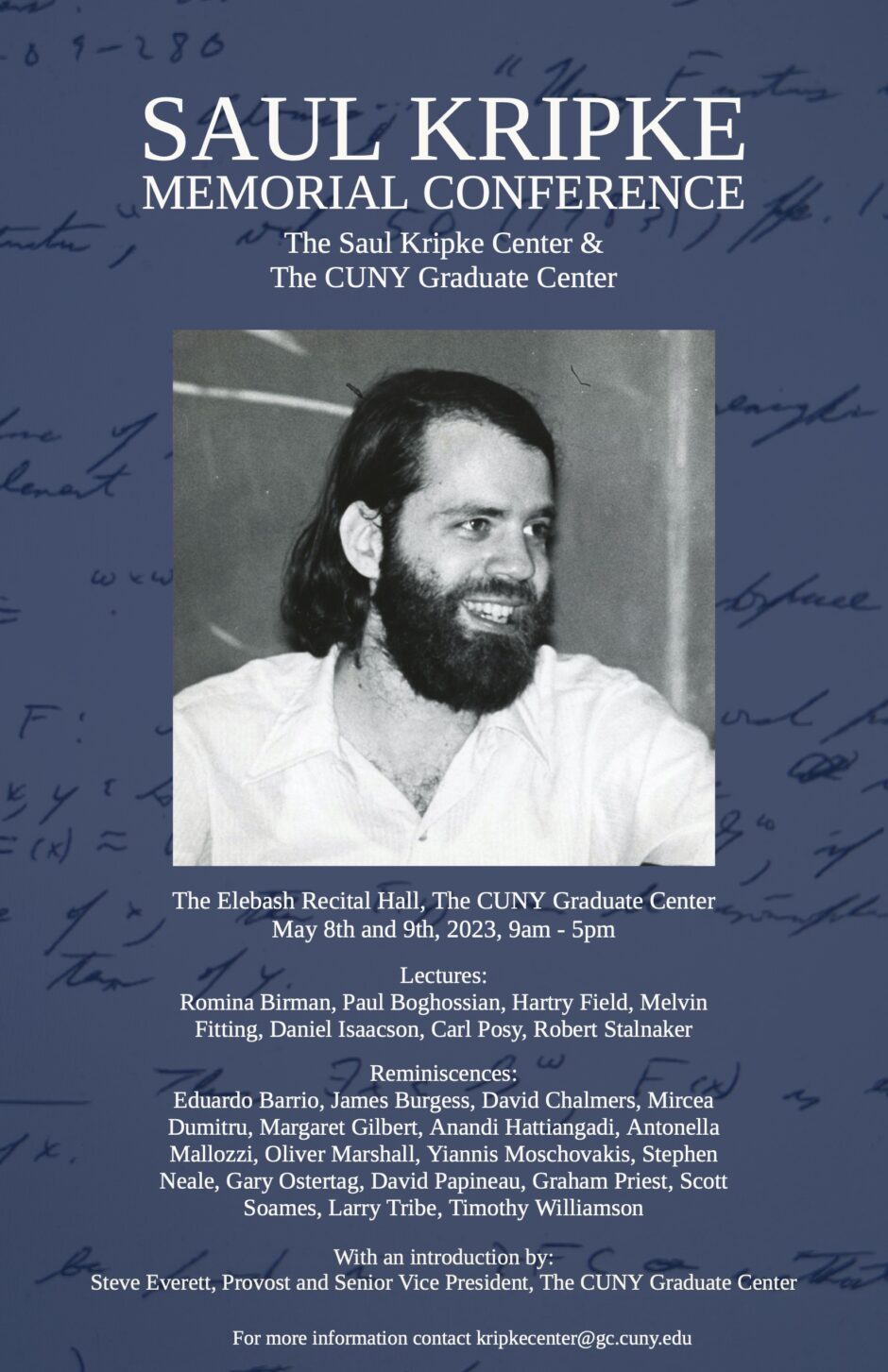
The Saul Kripke Center will host a memorial conference honoring Saul Kripke (1940-2022) at The CUNY Graduate Center on May 8th and 9th, 2023. The conference program is available here. Registration for attending in person is not required, but attendees will have to comply with the Graduate Center’s Building Access Policy. Although the conference will be a mainly in person event, a livestream is also available; for this, please register.

